


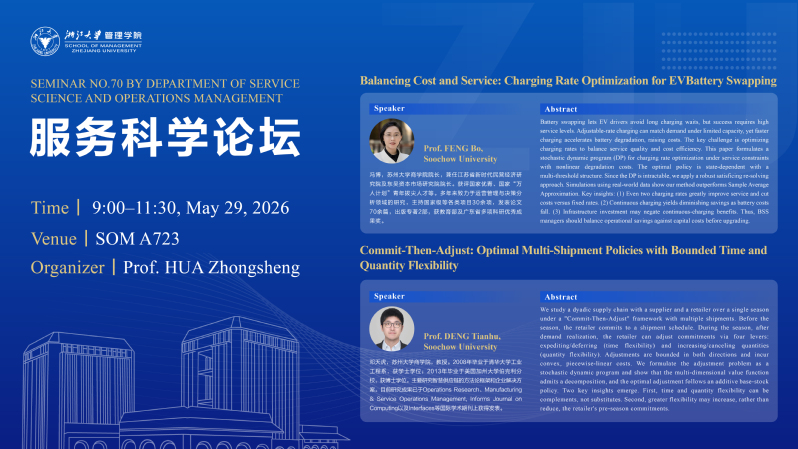
Time: 9:00–11:30, May 29, 2026
Venue: SOM A723
Organizer: Prof. HUA Zhongsheng
①Title: Balancing Cost and Service: Charging Rate Optimization for EV Battery Swapping
Speaker: Prof. FENG Bo, Soochow University

Bio:
冯博,苏州大学商学院院长,兼任江苏省新时代民营经济研究院及东吴资本市场研究院院长。获评国家优青、国家“万人计划”青年拔尖人才等。多年来致力于运营管理与决策分析领域的研究,主持国家级等各类项目30余项,发表论文70余篇,出版专著2部,获教育部及广东省多项科研优秀成果奖。
Abstract:
Battery swapping allows electric vehicle (EV) drivers to exchange depleted batteries for fully charged ones at dedicated stations, avoiding the lengthy waits associated with plug-in charging. The viability of this service hinges on maintaining a high service level. Emerging charging technologies enable continuously adjustable rates, allowing stations to flexibly match charging speed with fluctuating demand and thereby sustain high service levels under limited charging capacity. However, faster charging accelerates battery degradation, raising operational costs. Thus, the BSS faces the central challenge of optimizing charging rate to jointly ensure service quality and cost efficiency. In this paper, we formulate a stochastic dynamic program (DP) to optimize the charging rate of a BSS under service level constraints, explicitly accounting for nonlinear battery‐degradation cost. We show that the optimal policy has a state‐dependent, multi‐threshold structure. Because solving the DP directly is intractable, we employ a re‐solving approach to periodically solve a tractable approximation based on robust satisficing, yielding high-quality charging decisions that balance service levels and operating costs. Calibrated with real-world data, extensive simulations show that our approach consistently outperforms a benchmark policy based on Sample Average Approximation (SAA). Our numerical results yield three key insights: (i) Introducing even limited flexibility (two charging rates) substantially improves service levels and reduces costs compared to a fixed-rate policy; (ii) While fully continuous charging offers additional cost savings, its marginal benefit diminishes as battery costs decline; (iii) The potential investment required for advanced charging infrastructure can offset continuous‐charging benefits. Thus, BSS managers should carefully assess both operational‐cost savings and capital‐investment requirements before adopting advanced charging technologies.
②Title: Commit-Then-Adjust: Optimal Multi-Shipment Policies with Bounded Time and Quantity Flexibility
Speaker: Prof. DENG Tianhu, Soochow University

Bio:邓天虎,苏州大学商学院,教授。2008年毕业于清华大学工业工程系,获学士学位;2013年毕业于美国加州大学伯克利分校,获博士学位。主要研究智慧供应链的方法论框架和企业解决方案。目前研究成果已于Operations Research、Manufacturing & Service Operations Management, Informs Journal on Computing以及Interfaces等国际学术期刊上获得发表。
Abstract:
We study a dyadic supply chain with a supplier and a retailer over a single selling season where orders are delivered in multiple shipments under a “Commit-Then-Adjust” framework. Before the season, the retailer commits to a shipment schedule that specifies the order quantity for each shipment. During the season, after observing realized demand, the retailer can modify these commitments using four levers: expediting and deferring shipments (time flexibility) and increasing or canceling shipment quantities (quantity flexibility). These adjustments are bidirectional both in time and quantity but bounded by pre-specified upper and lower limits and incur convex, piecewise-linear costs. The optimal adjustment decision is a multi-dimensional function of the committed schedule, realized demand, and the adjustment bounds. We formulate the retailer’s in-season adjustment problem as a stochastic dynamic program and analyze a general class of bounded, bidirectional adjustment problems under convex, piecewise-linear costs. To overcome the curse of dimensionality, we show that the multi-dimensional value function admits a decomposition, either globally or within each subdomain induced by the ordering of state variables, and that the optimal adjustment follows an {\it additive base-stock policy}: the optimal adjustment equals the sum of regional adjustments, each governed by a classical base-stock rule. This structural result yields tractable characterizations of optimal Commit-Then-Adjust policies in both locally and globally adjustable multi-shipment settings. Our analysis delivers two main insights. First, contrary to the common view that different flexibility levers substitute for one another, we show that time and quantity flexibility can be complements: expanding one lever can increase the marginal value of the other. Second, we challenge the belief that greater flexibility necessarily reduces pre-season commitments. In our setting, enhanced flexibility can instead induce the retailer to commit to larger total order quantities.
欢迎广大师生前来交流!